Venice Carnival is one of the oldest and most visually extraordinary festival traditions in the world. The Carnevale di Venezia has roots going back to at least the 11th century, when the Republic of Venice celebrated a victory over the Patriarch of Aquileia with public celebrations that became an annual tradition. By the 18th century, the Venetian carnival had become the most famous celebration in Europe, drawing visitors from across the continent to a city that was simultaneously at the height of its cultural power and beginning its long political decline.
The modern carnival, revived in 1979 after decades of suppression under Napoleon and subsequent rulers, runs for approximately ten days before Ash Wednesday, typically in late January or February. It is one of the most photographed events in Europe and one of the most misunderstood by visitors who arrive expecting something more theatrical than what the public spaces of Venice actually contain.
This guide covers what Venice Carnival actually is, what to expect as an American visitor, and how to experience it properly.
What Venice Carnival Actually Is
Venice Carnival is best understood not as a single organised event but as a season — a period during which the city of Venice adopts a festive identity that permeates its public spaces, its restaurants and bars, its hotels, and its cultural institutions.
The public elements of the carnival are centred on St. Mark’s Square, where official events including the Flight of the Angel ceremony and the costume competition take place, and on the broader streets and campi of the city, which fill with costumed figures throughout the carnival period.
The private elements — the masked balls, the private parties, the exclusive dinners — are the events that most closely resemble the historical carnival tradition and are the ones that photographs of Venice Carnival most often depict. These events are separately ticketed and organised and require advance booking from specific event organisers.
Understanding the distinction between the free public carnival experience and the ticketed private events is the essential first step in planning a Venice Carnival visit.
The Public Carnival
St. Mark’s Square
Piazza San Marco is the centre of the public carnival experience. Throughout the carnival period, the square fills with costumed figures — some professional models and performers hired by photographers and costume suppliers, some visitors in their own elaborate costumes — who pose, promenade, and photograph each other in a continuous tableau.
The atmosphere in St. Mark’s Square during Venice Carnival is genuinely extraordinary. The combination of the Byzantine and Gothic architecture of the Basilica and the Doge’s Palace, the January or February light, and the presence of hundreds of people in elaborate historical Venetian costumes creates images that are unlike anything produced at any other festival anywhere in the world.
The Flight of the Angel ceremony, which opens the official carnival programme, involves a costumed figure descending on a wire from the campanile of St. Mark’s to the square below. The ceremony has been performed in various forms since the 17th century and draws the largest single crowd of the carnival period.
The costume competition, held in St. Mark’s Square during the carnival, judges entries in historical Venetian costume categories and is one of the events most worth attending for visitors interested in the craft of Venetian costume making.
The rest of Venice
Outside St. Mark’s Square, carnival spreads across the city in less concentrated but equally atmospheric ways. The streets, bridges, and campi of Dorsoduro, Cannaregio, and Castello all contain their own carnival activity — costumed figures walking between destinations, neighbourhood celebrations, and the general festive atmosphere of a city that has committed to the seasonal identity.
The Dorsoduro neighbourhood, home to the Accademia and the Peggy Guggenheim Collection, has a particularly pleasant carnival atmosphere because it is slightly removed from the tourist concentration of the areas immediately around St. Mark’s and Rialto while still being fully within the carnival environment.
The Private Masked Balls
The private masked balls are what most people imagine when they think of Venice Carnival, and they are genuinely extraordinary events — candlelit rooms in historic palaces, attendees in full 18th-century Venetian costume, music from period ensembles, and the particular atmosphere of a masked gathering in a setting that is itself historical.
The major balls are organised by specific event companies that work with Venice’s historic palazzi and institutions. The most famous and most expensive are the Doge’s Ball, held in the historic rooms of the Doge’s Palace itself, and the various balls held in Ca’ Rezzonico, Ca’ Sagredo, and other significant Venetian palaces.
Tickets for the major balls range from approximately 300 euros to several thousand euros per person depending on the event and the seating arrangement. Advance booking is required, typically months in advance for the most in-demand dates.
Attending a major Venice Carnival ball in full historical Venetian costume is one of the most extraordinary cultural experiences available to a visitor anywhere in the world. It is also a significant logistical and financial commitment that requires careful planning.
What to wear to a masked ball
Full historical Venetian costume is both expected and required at the major masked balls. The principal costume types of the Venetian carnival tradition have specific names and specific characteristics.
The Bauta is the most recognisably Venetian carnival costume — a white mask with a protruding chin that allows the wearer to eat and drink without removing it, worn with a black cape (tabarro) and a black tricorn hat. The Bauta was worn by all social classes during the historical carnival and was specifically associated with the anonymity that the carnival provided.
The Moretta is a small oval black velvet mask traditionally worn by women, held in place by biting on a button on the inside — which meant that the wearer could not speak while wearing it, a detail that contributed to the air of mystery that surrounded masked women in the historical carnival.
The Colombina is a smaller, more decorative half-mask that became associated with the Harlequin’s love interest in the Commedia dell’Arte tradition and is among the most popular costume choices for women at contemporary Venice Carnival events.
Costume rental is available from specialist shops in Venice throughout the carnival period. For visitors who want to attend a major ball in full costume without the cost and complexity of purchasing or commissioning a costume before travelling, rental is the practical option. Quality varies significantly between rental suppliers — book with an established supplier rather than the cheapest available option.
The Masks
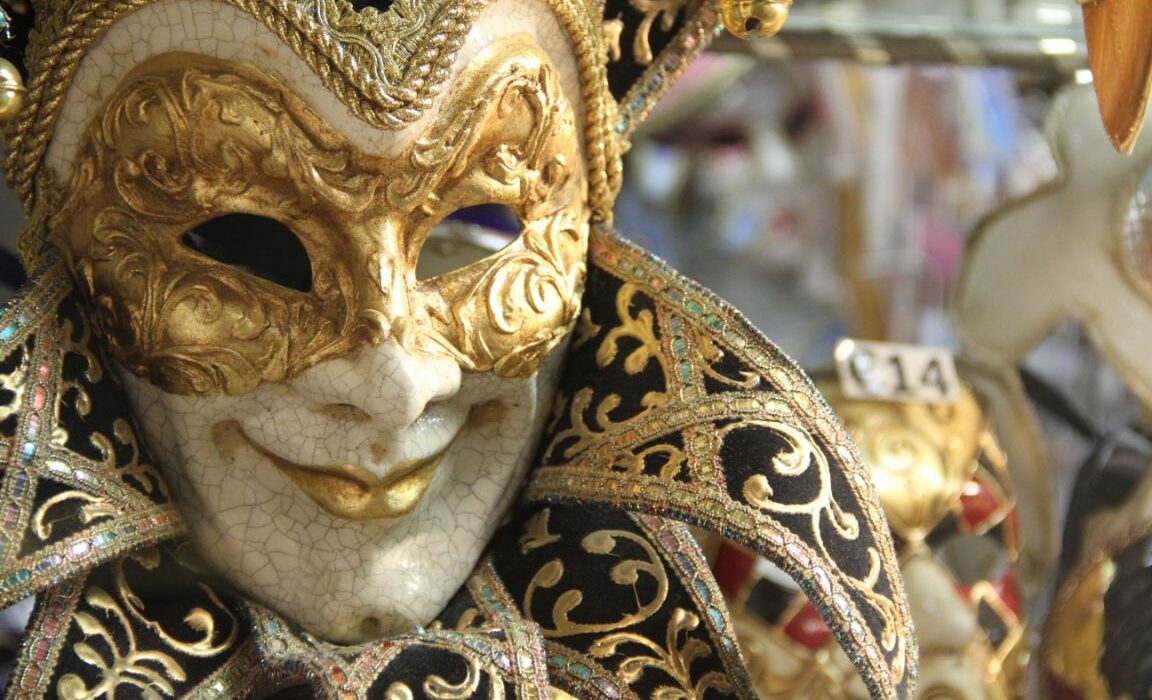
The traditional masks of Venice Carnival have their own history, craft tradition, and symbolism that rewards some understanding before you encounter them in the market stalls and artisan workshops of the city.
Venetian mask making — the arte dei mascareri — was a recognised guild trade in the Republic of Venice. The masks were used not only during carnival but throughout the year, as Venetian law permitted the wearing of masks in various public contexts as a way of equalising social distinctions in a highly stratified society.
The contemporary Venetian mask making tradition, largely revived along with the carnival in 1979, produces both commercial tourist masks and genuine artisan works. The difference is visible and significant. Commercial masks produced for the tourist market are typically made from papier-mâché or plastic in relatively simple forms. Artisan masks are made using traditional techniques — papier-mâché over clay moulds, finished with gesso, painted with pigments, and decorated with gold leaf, feathers, and gems — and represent significant craft investment.
Buying a genuine artisan mask from a Venice workshop is one of the most meaningful purchases available at any European festival event. Workshops to look for include Ca’ Macana in Dorsoduro, which is one of the oldest and most respected mask making workshops in the city, and Venetian Dreams in the Cannaregio neighbourhood.
When to Go
The timing of Venice Carnival varies each year with the Catholic liturgical calendar, since it culminates on Fat Tuesday before Ash Wednesday. The carnival typically runs for ten to twelve days, beginning on a Saturday or Sunday approximately two weeks before Ash Wednesday.
Within the carnival period, the best times for specific experiences are:
The first weekend provides the most concentrated atmosphere as the carnival begins, with events in St. Mark’s Square and the first major costume gatherings. Accommodation prices are high but the crowds have not yet reached their peak.
The middle weekdays offer the most manageable crowds and often the best opportunity for the atmospheric Venice experience — costumed figures against the backdrop of the city without the day-trip crowd pressure of the weekends.
The final weekend, culminating on Fat Tuesday, is the most festive and the most crowded. The finale events in St. Mark’s Square draw enormous crowds and the city is at its most atmospheric and its most congested simultaneously.
Practical Logistics
Getting to Venice
Venice Marco Polo Airport is served by connecting flights from major European hubs including Amsterdam, Frankfurt, London, and Paris, all of which have direct transatlantic connections from US cities. The journey from the airport to Venice city involves either a water bus (vaporetto) or a water taxi across the Venetian Lagoon, which provides an immediately striking introduction to the city.
Getting around Venice
Venice has no cars. Movement within the city is entirely on foot or by water. The vaporetto water bus service runs frequent services along the Grand Canal and around the perimeter of the city. On foot, Venice is a compact city that rewards walking and getting deliberately lost in the calli and campi of the neighbourhoods away from the main tourist routes.
Where to stay
Venice during carnival commands its highest accommodation prices of the year. Hotels in the Dorsoduro, Cannaregio, and Castello neighbourhoods offer proximity to the carnival atmosphere at generally lower prices than hotels immediately on or near St. Mark’s Square or the Rialto Bridge area. Book four to six months in advance for carnival dates.
The alternative of staying in Mestre, the mainland city connected to Venice by bridge, or in Padua an hour away by train, reduces accommodation costs significantly but requires daily commuting into Venice.
What to bring
The late January or February timing of Venice Carnival means cold and sometimes wet weather. Venice in winter is genuinely cold — temperatures typically range from 35 to 50 degrees Fahrenheit during the carnival period — and the damp of the lagoon makes the cold feel sharper than the air temperature alone suggests.
Waterproof footwear is specifically important in Venice because acqua alta — the seasonal flooding of the lower areas of the city — occurs regularly in winter. St. Mark’s Square is the area most affected by acqua alta, and the boardwalks that the city erects on the square during flooding events are worth knowing about before you go.
FAQ
Do I need to wear a costume to attend Venice Carnival?
No. Street clothes are perfectly acceptable for the public outdoor carnival experience. Costume is required for the private masked balls and is expected for the costume competition and formal carnival events. Many visitors choose to wear a simple Venetian mask as a compromise between street clothes and full costume that allows participation in the carnival atmosphere without the cost and complexity of a complete costume.
Is Venice Carnival worth attending without going to a masked ball?
Yes. The public carnival experience — the atmosphere of St. Mark’s Square filled with costumed figures, the costumed walking through the streets of Venice, the mask markets and artisan workshops — is genuinely extraordinary and worth experiencing independently of the private balls.
How much does Venice Carnival cost?
The public elements of the carnival are free to experience. Accommodation during carnival is at its annual peak. A genuine artisan mask from a Venice workshop costs from around 50 euros for a simple piece to several hundred for an elaborate one. Ticket prices for the major masked balls range from approximately 300 euros to several thousand euros per person. A mid-range Venice Carnival trip for an American visitor, including flights, three to four nights of accommodation, food, and activities but excluding a major ball, costs approximately 1,500 to 2,500 dollars.
When is Venice Carnival 2025 and 2026?
Venice Carnival dates change each year with the Catholic liturgical calendar. For specific dates in any given year, check the official Venice Carnival website, which publishes dates and the full programme of events for the upcoming carnival season.