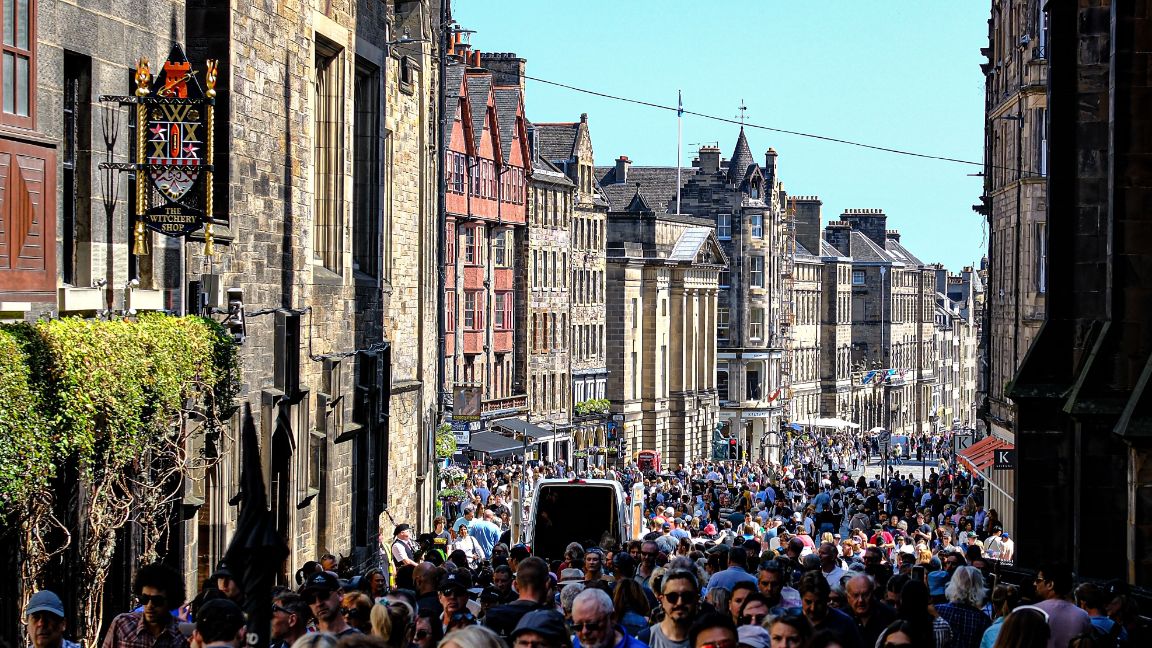
The Edinburgh Festival Fringe is the largest arts festival in the world. Every August, the Scottish capital hosts around 50,000 performances across approximately 300 venues over three weeks, drawing performers and visitors from across the globe to one of the most beautiful and walkable cities in Europe.
For American visitors, the Edinburgh Fringe represents one of the most rewarding and most accessible European cultural experiences available. It is conducted entirely in English. Edinburgh is served by direct transatlantic flights and by a short connection from London. The city is compact enough to walk everywhere. And the concentration of extraordinary comedy, theatre, dance, circus, and experimental performance available across three weeks makes it a compelling reason to visit Scotland in August specifically rather than at any other time of year.
This guide covers everything an American visitor needs to know before attending the Edinburgh Fringe for the first time.
What the Fringe Actually Is
The Edinburgh Festival Fringe began in 1947 when eight theatre companies who had not been invited to perform at the newly established Edinburgh International Festival showed up anyway and performed on the margins — the fringe — of the official programme. The open-access model that resulted from that act of creative defiance has been the defining principle of the Fringe ever since.
Any performer or company can perform at the Edinburgh Fringe without any selection or curation process. Any venue that applies can host shows. There is no panel deciding what is worthy of being programmed. The result is a festival that simultaneously contains some of the best new performance work in the world and some of the worst, with no reliable external indicator to distinguish between them before you attend.
This open-access model is both the Fringe’s greatest strength and its greatest challenge for first-time visitors. The 50,000 performances across three weeks span every form of artistic expression — stand-up comedy, sketch comedy, musical theatre, dramatic theatre, dance, circus, magic, storytelling, spoken word, opera, physical theatre, puppetry, and categories that do not fit any existing label. The programme is so large that navigating it effectively requires a specific approach.
Navigating the Programme
The Fringe app and website
The Edinburgh Fringe app and website contain the full programme with show descriptions, times, venues, ticket prices, and reviewer ratings. Browsing the full programme is effectively impossible — the size defeats any attempt at comprehensive review. The tools that make it navigable are the search filters, the reviewer ratings, and the recommendations from people who have attended before.
The star rating system, where professional critics from major outlets review shows throughout the Fringe and assign ratings from one to five stars, is the most widely used navigation tool. Five-star reviews from credible outlets are reliable positive indicators. Four-star reviews from multiple outlets is a strong signal. Three-star reviews indicate competent but not outstanding work. Below three stars generally signals something to avoid.
The catch is that reviews take time to accumulate. The first few days of the Fringe are largely unreviewed, and the most in-demand shows sell out before significant reviews appear. For shows with limited runs, booking based on description and reputation before reviews appear is often necessary.
The Royal Mile
The Royal Mile, the historic main street of Edinburgh’s Old Town running between the castle and the Palace of Holyroodhouse, becomes a continuous outdoor performance space during the Fringe. Hundreds of performers and companies promote their shows with impromptu performances throughout the day, distributing flyers and providing a direct experience of their work to potential audience members.
The Royal Mile performances are free to watch, genuinely entertaining in their own right, and an excellent way to discover shows you would not have found through the programme alone. A company whose 15-minute Royal Mile preview genuinely entertains you is likely to be worth seeing in their full show.
The art of taking flyers selectively — accepting the ones that genuinely interest you and declining the rest politely — is a learned skill that regular Fringe visitors develop quickly. The volume of flyers offered on the Royal Mile is significant, and developing a polite but efficient way to decline unwanted ones reduces the stress of walking through the busiest sections.
The Late Night Variety approach
One of the most reliable strategies for Fringe first-timers is attending late-night variety shows — late-night bills that present multiple short acts on a single programme, usually in a comedy or cabaret format. These shows introduce you to a range of performers in a single sitting, give you direct experience of the Fringe’s variety, and often contain the most surprising and memorable performances of any visit.
The Gilded Balloon, Assembly Rooms, and Pleasance venues all run late-night variety programming throughout the Fringe that is specifically designed as an introduction to the range of what is available.
The Venues
The Edinburgh Fringe venues range from the Assembly Hall of the Church of Scotland to basement bars with seating for 20 people. Understanding the venue geography and the character of the major venue groups helps navigate the programme.
The Big Four
The Fringe’s largest professional venue operators are the Pleasance, the Assembly, the Gilded Balloon, and Underbelly. These four organisations run multiple venues each, curate their own programmes within the open-access Fringe, and tend to present the most commercially developed and critically reviewed work. For first-time visitors who want the most reliable quality indicators, shows at the Big Four venues have been through at least some level of venue operator assessment and tend to have more professional production values than the most independent productions elsewhere.
Free Fringe venues
The Free Fringe is a significant parallel programme within the Edinburgh Fringe in which shows are presented free of charge in pub back rooms, community halls, and other venues, with performers relying on voluntary donations from the audience. The Free Fringe contains some of the most interesting and experimental work at the Fringe, performed by artists who cannot afford the venue fees of the major operators.
Attending Free Fringe shows as a complement to ticketed shows at the major venues gives you access to the full range of what the Fringe contains, including work that would not exist if it required commercial venue fees.
The Fringe Society venue
The Edinburgh Fringe Society’s own venue space is the Hub, a converted church at the top of the Royal Mile, which serves as both a performance venue and the administrative heart of the festival. The Fringe Box Office at the Hub is where physical tickets can be collected and where programme information is most comprehensively available.
What to See
Specific recommendations for the Edinburgh Fringe are impossible to give in advance because the programme changes entirely each year. The approach to finding shows worth seeing is more useful than any specific recommendation.
Comedy
Edinburgh in August is where stand-up comedy comes to be reviewed, discovered, and career-defined. The Perrier Comedy Award (now the Edinburgh Comedy Award) has been given to performers including Rowan Atkinson, Stephen Fry, Hugh Laurie, Steve Coogan, and dozens of others who went on to major careers. The comedy programme at the Fringe is the most competitive and most scrutinised comedy environment in the world.
For American visitors, British stand-up comedy at the Edinburgh Fringe introduces comic sensibilities and reference points that are different from American stand-up in interesting ways. Some British comedy translates immediately for American audiences. Some requires more cultural context. Both are worth experiencing.
Theatre
The theatre programme at the Fringe ranges from major professional productions by established companies to student productions from drama conservatoires, one-person shows, and experimental works that would not find a home in commercial theatre anywhere. The best Fringe theatre is genuinely extraordinary — work that is urgent, specific, and alive in ways that subsidised or commercial theatre rarely achieves.
For American visitors, Scottish and British theatre at the Fringe introduces perspectives and theatrical approaches that are different from Broadway or regional American theatre traditions. The physical performance tradition, the political directness, and the formal experimentation available across the Fringe theatre programme reward engagement.
Dance and Physical Theatre
The dance programme at the Fringe is smaller than the comedy and theatre programmes but contains some of the most purely impressive performance available during the festival. Contemporary dance companies from across the world present work at the Fringe that is on the festival circuit specifically because of the critical attention and industry presence that the Fringe generates.
Getting to Edinburgh
Flying
Edinburgh Airport is served by direct transatlantic flights from a limited number of US cities and by connecting flights through London Heathrow, London Gatwick, Dublin, and Amsterdam. Direct flights from New York and other East Coast cities are available on some carriers.
The most economical routing for most Americans is a connecting flight through London or Dublin. From London, Edinburgh is 90 minutes by air or 4 hours 30 minutes by train from London Kings Cross — the train is often comparable in total travel time once airport transit is factored in and is significantly more comfortable and convenient for visitors staying in central Edinburgh.
Getting from the airport to the city
Edinburgh Airport is connected to the city centre by the Edinburgh Trams line, which runs directly to Princes Street at the heart of the city centre in approximately 30 minutes. The tram is reliable, affordable, and the most practical option for most visitors arriving without enormous amounts of luggage.
Where to Stay
Edinburgh’s accommodation during the Fringe is significantly more expensive and more limited than at other times of year. The August festival period is the most in-demand accommodation period in Edinburgh’s calendar, and prices at hotels and guesthouses are at their annual peak.
Book early
Booking accommodation for the Edinburgh Fringe in August should be done as early as possible, ideally six months to a year in advance for stays during the peak festival weeks. Hotels in the city centre and Old Town are the most convenient for the Fringe venues but are also the most in-demand and most expensive.
Consider the New Town and Leith
Accommodation in Edinburgh’s New Town, just north of the Princes Street gardens, and in the port neighbourhood of Leith to the north are both connected to the Old Town by a manageable walk or frequent bus service and are often more available and more affordable than Old Town hotels.
Serviced apartments
Serviced apartments for week-long or fortnight-long stays are a practical option for visitors planning to attend the Fringe for multiple days, offering more space than a hotel room and kitchen facilities that reduce restaurant dependency over a longer stay.
Practical Tips
Buy tickets in advance for shows you specifically want to see. The most in-demand comedy shows sell out weeks before the festival and often before reviews accumulate. If there is a specific performer or show you are coming to Edinburgh to see, book before you go.
Leave room for spontaneity. Do not schedule every hour of every day with pre-booked shows. Some of the best Fringe experiences come from deciding on the day to see something based on a Royal Mile encounter, a review you read over breakfast, or a recommendation from someone in a queue.
Walk everywhere. Edinburgh’s Old Town is one of the most beautiful and walkable urban environments in the world, and the Fringe venues are concentrated across a relatively compact area. Walking between venues, across the Grassmarket, up and down the closes off the Royal Mile, and through the Princes Street gardens is not transit — it is part of the experience.
Eat well outside the venue areas. The Royal Mile and Grassmarket restaurant options are tourist-oriented and often overpriced relative to quality. The Leith area, Stockbridge, and the Newington neighbourhood south of the Fringe venues contain excellent restaurants at more reasonable prices that are worth the slight detour.
Go to at least one Free Fringe show. The contrast between a polished Big Four venue production and a Free Fringe show in a pub back room captures the full range of what the Edinburgh Fringe is in a way that attending only ticketed shows does not.
FAQ
How many shows should I try to see per day at the Edinburgh Fringe?
Two to four shows per day is a comfortable pace for most visitors. More than four shows per day produces a quality of attention in the later shows that is below what the performances deserve. The gap time between shows — walking between venues, eating, recovering from the previous show — is not wasted time but part of the Fringe experience.
Is the Edinburgh Fringe worth the cost?
For visitors who engage actively with the programme rather than attending passively, yes. The Edinburgh Fringe provides access to more extraordinary live performance in a single week than most cities offer across an entire year. The cost of flights, accommodation, and tickets is the real barrier for American visitors rather than the festival experience itself.
What is the difference between the Edinburgh Fringe and the Edinburgh International Festival?
The Edinburgh International Festival is a separate, separately curated event that runs concurrently with the Fringe in August. It is a more conventional arts festival with a selected programme of classical music, opera, dance, and theatre from established international companies. The Fringe is the open-access event. Most visitors who come specifically for the festival experience attend the Fringe. Many who come to Edinburgh in August attend both.
Is Edinburgh safe for American solo travellers?
Yes. Edinburgh is one of the safest cities in Europe by any measure, and the Fringe period, with its enormous international visitor population and significant event security presence, is among the more well-managed public event periods in any European city. Normal city travel awareness applies but specific safety concerns for American visitors are minimal.