Mardi Gras is one of the most famous celebrations in the world and one of the most misunderstood. Most people outside of Louisiana associate it with the French Quarter on Fat Tuesday — the beads, the balconies, the crowds. That version is real, but it is only a small part of what Mardi Gras actually is. The full picture is a six-week season of parades, music, food, and community celebration rooted in the Catholic calendar, African American cultural tradition, and the particular identity of New Orleans as a city unlike any other in the United States.
This guide covers what Mardi Gras is, where and when it happens, what to expect if you attend, and how to engage with it as a visitor in a way that does justice to what the celebration actually means.
What Mardi Gras Means
Mardi Gras is French for Fat Tuesday. It refers specifically to the Tuesday before Ash Wednesday, the day that marks the beginning of Lent in the Catholic tradition. Lent is a period of fasting and penitence, and Mardi Gras is the final day of feasting before it begins. The name and the tradition come from France through French colonial Louisiana, and New Orleans has been celebrating it in some form since the city’s founding in 1718.
The broader season is Carnival, which runs from January 6th — Epiphany, the Twelfth Night after Christmas — through Fat Tuesday. In New Orleans, the Carnival season is marked by increasingly elaborate celebrations, costume balls, and parades that build in frequency and intensity as Fat Tuesday approaches.
The colors of Mardi Gras — purple, gold, and green — were assigned specific meanings by Rex, the King of Carnival, in 1892. Purple represents justice, gold represents power, and green represents faith.
The Parade Tradition
Parades are the heartbeat of New Orleans Mardi Gras and the element that most distinguishes it from any other celebration anywhere in the world. The parade season builds from a few events in January to dozens of parades in the final two weeks before Fat Tuesday, with multiple parades often running simultaneously through different parts of the city.
Krewes
Parades are organized and funded by krewes — private social organizations that have been central to New Orleans Carnival culture since the 19th century. Each krewe designs and builds its own floats, selects its king and queen, and throws its own specific mix of items to the crowd. The oldest and most prestigious krewes include Rex, Comus, Proteus, and Momus, all of which have been parading since the 19th century.
Some krewes are by invitation only and deeply exclusive. Others have opened their membership significantly. The superkrewes — Endymion, Bacchus, and Orpheus — operate at enormous scale, with hundreds of floats and celebrity monarchs, and their parades are among the most spectacular events in the entire Carnival season.
Krewe du Vieux, which parades in the French Quarter and Marigny, is one of the most satirically sharp and visually provocative parades in New Orleans, known for adult-themed floats and biting political commentary. It is deeply loved by locals and often among the most interesting parades of the season for visitors who want something beyond the mainstream.
Throws
The tradition of throwing items from floats to the crowd is central to the Mardi Gras parade experience and has a culture all its own. Beads are the most famous throws, but the range of items available from floats has expanded enormously over the decades. Doubloons — aluminum or plastic coins stamped with the krewe’s emblem — were introduced by Rex in 1960 and remain collectible items. Cups, stuffed animals, sunglasses, footballs, decorated coconuts from the Zulu krewe, and specialty throws from individual riders are all part of the catch.
Yelling “Throw me something, mister!” is the standard appeal to float riders. Standing near the front of the crowd, making eye contact with riders, and using good-natured enthusiasm rather than aggressive grabbing tends to result in more throws. The culture of the catch is participatory and joyful rather than competitive.
The route
Most of the major Uptown parades run along a route that includes St. Charles Avenue and Canal Street, the main parade corridor. Families typically stake out territory along the parade route early, setting up ladders with children’s seats mounted on top that have become a signature sight of the New Orleans parade experience. The same families often return to the same spots year after year.
The Metairie parades, which run in the suburban parish west of New Orleans, are excellent alternatives for families who find the city parades overwhelming in their scale and crowd density.
The Food
New Orleans does not make bad food in ordinary times, and Mardi Gras season is when the city’s restaurants, bakeries, and street food vendors operate at their most energetically celebratory. The food dimension of Mardi Gras deserves as much attention as the parades.
King cake
King cake is the defining food of the Mardi Gras season, available in bakeries and at every gathering from January 6th through Fat Tuesday. It is a ring-shaped pastry, typically made from a brioche or cinnamon roll dough, decorated with icing in purple, gold, and green sugar. A small plastic baby is baked inside — in older tradition it was an actual bean — and the person who finds the baby in their slice is traditionally obligated to buy the next king cake or host the next party.
The king cake tradition traces to the Feast of the Epiphany and the Three Kings who visited the infant Jesus, and the cake is eaten throughout Carnival season in homes, offices, schools, and social gatherings across New Orleans. The range of king cake varieties has expanded enormously over the decades to include cream cheese filled, praline, Bavarian cream, and dozens of other variations.
Visitors who want to take king cake home face a logistical challenge — the cakes are available only from approximately January 6th through Fat Tuesday, and many New Orleans bakeries ship nationally during the season. Gambino’s, Dong Phong, and Randazzo’s are among the most widely shipped.
Gumbo and Creole cuisine
Mardi Gras season is gumbo season in New Orleans, and the connection between the holiday and the food is genuinely cultural rather than merely commercial. Gumbo, the stew that is possibly the most complex and culturally layered dish in American cuisine, appears everywhere during Carnival. The roux-based dark gumbo with sausage and chicken, the seafood gumbo with shrimp and crab, the okra gumbo — each is a different expression of the same culinary tradition.
Jambalaya, red beans and rice, crawfish etouffee, beignets, and the full Creole and Cajun repertoire that makes New Orleans one of the great food cities in the world are all available in extraordinary form during Mardi Gras season. Eating well in New Orleans during Carnival requires almost no effort beyond walking into the right restaurants, which are abundant.
Street food
The parade routes and festival areas are lined with food vendors selling festival-specific food. Crawfish Monica, a pasta dish with crawfish in a creamy sauce, has been a parade food staple for decades. Frozen drinks in elaborate take-home cups are a New Orleans street food tradition. Corn dogs, fried foods, and the various offerings of the food trucks and stands that set up along parade routes are part of the parade experience.
The Music
New Orleans is the birthplace of jazz and a city with a musical culture that permeates every aspect of daily life. Mardi Gras season brings this musical culture to a particular intensity.
Second line parades
Second line parades — informal parades led by a brass band with a following crowd that dances behind — are a New Orleans tradition that happens year-round but reaches its highest frequency and energy during Mardi Gras season. The brass band traditions of New Orleans, rooted in African American musical culture and influenced by the marching band traditions brought by European immigrants, produced one of the most distinctive musical forms in the world.
Walking behind a brass band through the streets of a New Orleans neighborhood during Carnival season, with hundreds of people dancing around you and the music filling the air, is one of the genuinely irreplaceable experiences available anywhere in the United States.
Live music venues
The French Quarter’s live music venues operate at full capacity throughout Carnival season, with Frenchmen Street in the Marigny neighborhood offering some of the best concentrated live music in the country in a smaller, more intimate setting than the Quarter itself. The music continues until the early hours every night of the Carnival season.
The Costumes
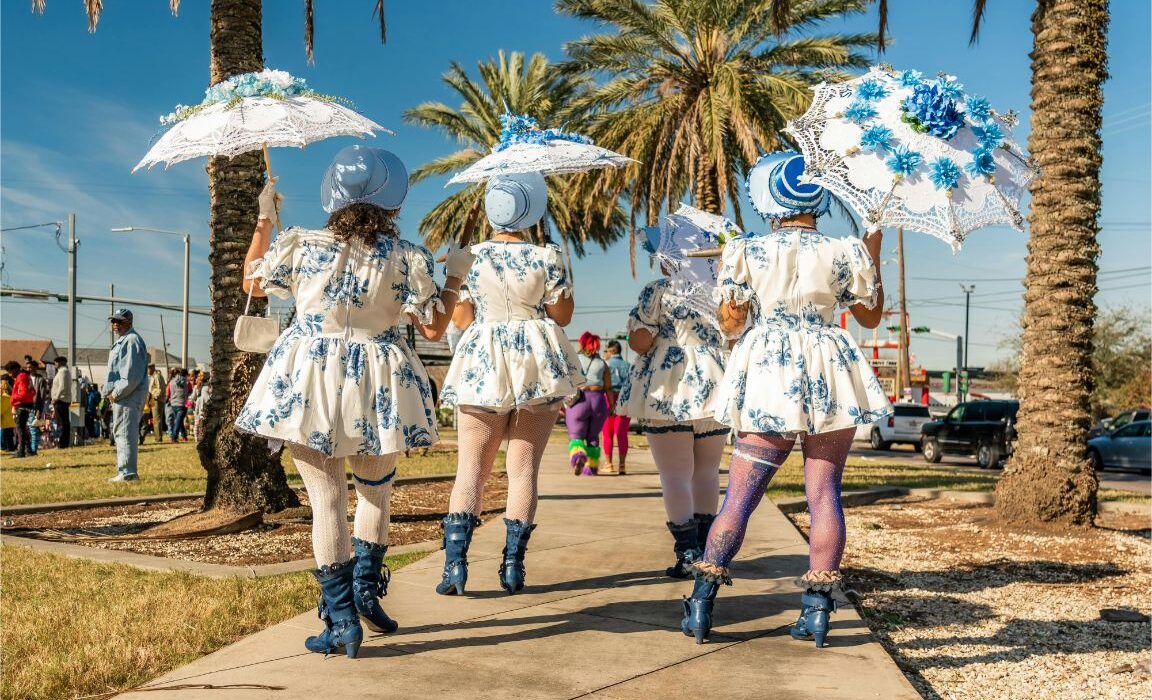
Costuming is a serious art form in New Orleans Mardi Gras, with a tradition of elaborate, handmade, often satirical costumes that goes back to the earliest Carnival celebrations. The costume culture reaches its most concentrated expression on Fat Tuesday itself, when the French Quarter fills with people in the most creative and elaborate costumes you will see anywhere outside of Venice Carnival.
The Mardi Gras Indians deserve specific recognition. African American tribes called Mardi Gras Indians have been sewing elaborate beaded and feathered suits for Carnival since the late 19th century, and their suits — which take an entire year to construct and are never worn twice — represent some of the most extraordinary textile art produced in America. The Mardi Gras Indians parade through their own neighborhoods rather than along the official parade routes, and witnessing them in their full regalia is one of the most remarkable things available to see during Carnival season.
What to Expect as a Visitor
When to go
The final week before Fat Tuesday is the most intense and the most crowded period of the season. The Krewe of Endymion parades on the Saturday before Fat Tuesday, Bacchus on Sunday, and the final days Monday and Tuesday bring the highest concentration of activity. Accommodation in New Orleans during this final week is at its annual peak price and books out months in advance.
Attending the parades in the second-to-last week — typically beginning with Krewe du Vieux on the Saturday two weekends before Fat Tuesday — provides access to genuinely spectacular parades with more manageable crowds and more reasonable accommodation prices.
Where to stay
The French Quarter is the most central location for Mardi Gras attendance but has limited accommodation relative to demand during peak weeks. The Garden District, Uptown, and Mid-City neighborhoods offer more availability and put you closer to the major Uptown parade routes along St. Charles Avenue. The CBD and Warehouse District have numerous hotel options with good access to both the French Quarter and the parade routes.
Renting a house or apartment in a residential neighborhood through vacation rental platforms is a popular option for groups and provides a base with more space and a more local experience than a hotel.
Day of arrival planning
The major parades are publicly announced well in advance on the Arthur Hardy Mardi Gras Guide website, which publishes the full parade schedule, routes, and krewe information. Planning your days around specific parades and arriving at the route early to secure a good viewing position is the basic strategy for getting the most out of the parade experience.
The French Quarter on Fat Tuesday
The French Quarter on Fat Tuesday is the version of Mardi Gras that most outsiders picture, and it is genuinely extraordinary in its energy and scale. The streets of the Quarter are closed to traffic and fill with hundreds of thousands of people in costume throughout the day. The balconies of the buildings on Bourbon Street and Royal Street are packed with people throwing beads to the crowd below.
This experience is adult-oriented in a way that the neighborhood parade experience in Uptown or Mid-City is not. The French Quarter on Fat Tuesday is loud, crowded, and oriented around alcohol and the theatrical license that the occasion provides. It is one of the most energetically festive environments available anywhere in the world on that specific day, and it is a genuinely different experience from the family parade culture that defines Mardi Gras in the residential neighborhoods.
Both versions are authentic. New Orleans Mardi Gras contains both the family parade experience on St. Charles Avenue and the adult street party in the French Quarter, and which experience you prioritize shapes what your Mardi Gras visit will be.
FAQ
When is Mardi Gras?
Mardi Gras falls on the Tuesday before Ash Wednesday, which places it between February 3rd and March 9th depending on the year. The date changes each year in accordance with the Catholic liturgical calendar, which ties Ash Wednesday to Easter. Checking the specific date for the year you plan to attend is important for planning.
Is Mardi Gras only in New Orleans?
No. Mobile, Alabama holds the oldest continuous Mardi Gras celebration in the United States, predating New Orleans. Galveston, Texas; Biloxi, Mississippi; and various smaller communities across Louisiana all hold their own Mardi Gras celebrations. But New Orleans is the largest and most culturally significant, and when most people refer to Mardi Gras in America, they mean New Orleans.
Is New Orleans Mardi Gras appropriate for families?
Yes, with appropriate planning. The neighborhood parade experience in Uptown, Mid-City, and the suburban Metairie routes is explicitly family-oriented. Families with children attend by the hundreds of thousands. The French Quarter on Fat Tuesday is a different environment entirely and not appropriate for children. The key is understanding which aspects of Mardi Gras you are participating in.
How much does it cost to attend Mardi Gras?
The parades are free to attend. The city itself is available to explore without any ticket or entry fee. The costs are accommodation, food, and drinks, all of which are at their annual peak pricing during Carnival season. Budget accommodation options exist further from the city center. The food cost is whatever you choose to spend at the city’s extraordinary restaurants and street food vendors, and eating exceptionally well for a moderate budget is entirely achievable in New Orleans.
Do I need to show anything to get beads?
No. The beads thrown from parade floats are thrown to anyone in the crowd who asks, with no requirement of any kind. The reputation of Mardi Gras for requiring exposure in exchange for beads refers to a specific and narrow behavior that occurs on certain balconies in the French Quarter and is not representative of the broader parade culture. Families, children, and visitors of all ages catch beads at every parade along the official routes simply by being enthusiastic and present.