Halloween decoration has become one of the most creative and competitive home displays of the year. Drive through any American neighbourhood in October and you will find setups that range from a single jack-o-lantern on a porch step to elaborate multi-zone haunted house productions that took weeks to plan and install.
Whether you are starting from scratch or building on an existing collection, this guide covers the best Halloween decoration ideas for your home, indoors and out, with practical guidance on what works, what lasts from year to year, and where to focus your effort for the best results.
Porch and Entrance Decorations
The porch and front entrance are where Halloween decoration makes its biggest impression. This is what trick-or-treaters approach, what neighbours see from the street, and where the transition from ordinary home to Halloween setup is most concentrated. Getting this area right matters more than anything else.
The layered porch approach
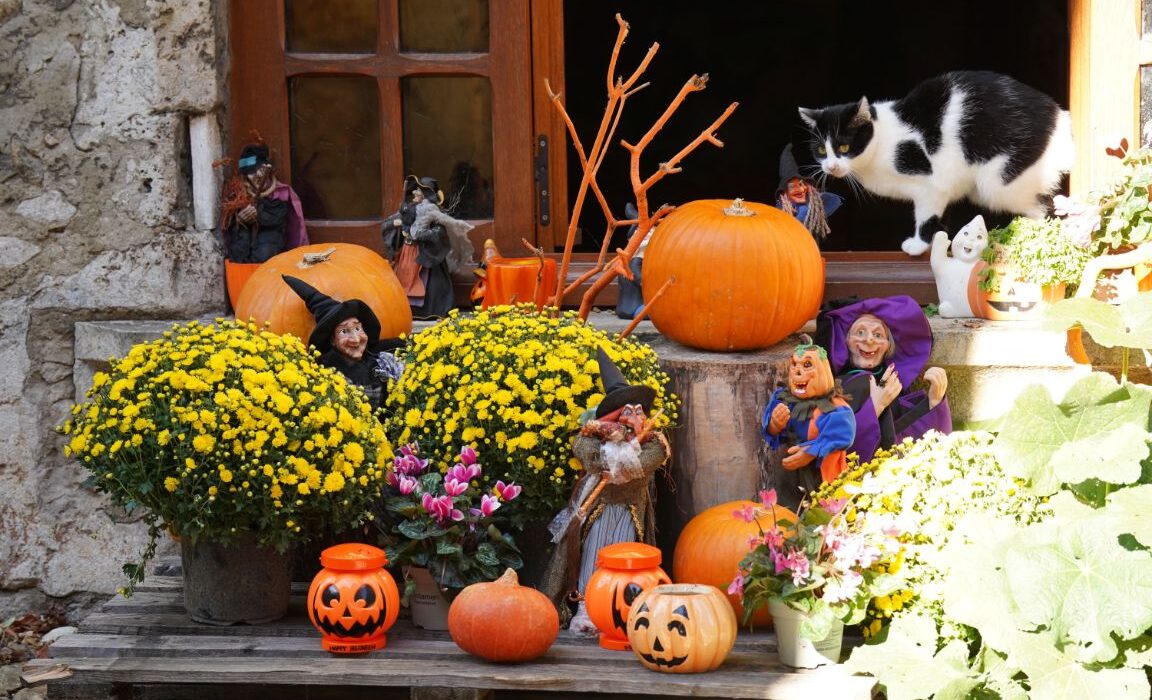
The most effective porch setups work in layers, with something at ground level, something at mid-height, and something at eye level or above, creating visual depth rather than a flat row of items.
Ground level: Pumpkins of varying sizes grouped in odd numbers (three or five looks more natural than two or four), hay bales, potted plants in seasonal colours, or a low fog machine effect. A cluster of different-sized pumpkins at the base of porch steps is the classic starting point because it works and because it is endlessly adaptable by how you carve or paint the pumpkins.
Mid-height: Potted mums in orange, deep red, or purple. Lanterns with battery-operated candles. A cauldron prop. A seated skeleton or scarecrow in a porch chair. These items give the middle zone of your porch visual interest without overwhelming the space.
Eye level and above: A wreath on the door. Window silhouettes. String lights along the porch roof or railings. Hanging ghost decorations from a porch ceiling. Bunting in orange and black across the railing. This top layer frames everything below and makes the whole display feel complete rather than collected.
Front door styling
The front door is the centrepiece of any porch Halloween display and deserves specific attention.
A Halloween wreath is the most popular front door decoration and comes in a range from simple orange and black ribbon arrangements to elaborate constructions incorporating artificial flowers, skulls, bats, pumpkins, and LED lighting. The best wreaths are sturdy enough to survive a month of weather and hold their shape through the season. Foam-based wreaths with wired attachment points tend to outlast fabric or paper ones significantly.
Door decals and clings are an underrated option for renters or people who want an impressive effect without permanent installation. High-quality vinyl door decals can transform a plain door into a convincing haunted house entrance, a giant spider web with a central spider, or a skeletal figure reaching through the door. They peel off cleanly at the end of the season when applied to a smooth surface.
Front Yard Displays
Front yard displays are where Halloween decoration can become genuinely theatrical. The space available in most American front yards allows for setups that would not fit on a porch, and the visual impact from the street can be considerable.
Graveyard scenes
A DIY graveyard is one of the most popular and consistently effective front yard Halloween displays. Foam or plastic tombstones, available at every seasonal retailer from late September, can be arranged in a naturalistic cluster with some upright, some tilted, and some partially obscured by strategically placed plants or hay. Adding a skeleton hand or foot emerging from the ground near a tilted stone, a low fog effect along the ground, and uplighting on the stones creates a scene with real visual depth.
The key to a good graveyard is not overloading it. Five well-placed tombstones with accessories look better than fifteen tombstones crammed into the same space. Leave room between elements for the fog or lighting to work.
Inflatables
Halloween inflatables have become enormously popular because they are quick to set up, pack down compactly for storage, and create immediate visual impact from the street. The range available now runs from simple 3-foot pumpkins to 12-foot monsters with internal lighting and motion effects.
The practical considerations for inflatables are worth knowing. They require a nearby power outlet or an extension cord long enough to reach one, and they need to be staked down adequately for windy nights. They also deflate during the day if you turn them off to save energy, which some neighbourhoods find less attractive than the inflated display. A timer that turns them on at dusk and off after midnight handles this elegantly.
Quality varies considerably in the inflatable market. Better-quality inflatables use thicker nylon, have more powerful fans that maintain their shape in wind, and have brighter internal LED lighting that holds up over weeks of nightly use.
Spider web displays
Stretch cotton spider web material is one of the most cost-effective decorating materials available and can cover large areas of shrubs, fences, railings, and porch columns convincingly for very little money. The effect depends heavily on lighting and on adding plastic spiders at irregular intervals throughout the web. A well-lit spider web across a large hedge or fence section from the street looks substantially more impressive than its material cost would suggest.
Windows and Exterior Lighting
Windows are the most underused exterior decoration surface in most Halloween setups. Lighting and silhouettes in windows create visual interest from the street at night and transform the appearance of a house significantly.
Window silhouettes
Backlit window silhouettes, either purchased as cut-outs or printed at home and adhered with temporary mounting strips, create the impression of figures and scenes inside an illuminated house. A silhouette of a witch stirring a cauldron, a hunched figure, or a collection of bats clustered in a corner reads clearly from the street when backlit with a warm light source inside the room. Black card or heavy paper cut to shape and held with temporary adhesive works for DIY versions. Pre-made silhouette sets are available in a range of scenes from subtle to elaborate.
Projection effects
Halloween projectors, which cast animated effects onto the exterior of a house or onto a screen in a window, have grown significantly in quality and affordability over the past several years. A projector mounted on a stake in the front yard and aimed at the facade of the house can display animated ghosts, falling leaves, lightning storm effects, or moving skeletons that create a dynamic display without any permanent installation.
Dedicated Halloween projection screens for windows allow interior projectors to display animated scenes, such as a crackling fire with skeletons, zombies approaching from inside, or a haunted laboratory, that are visible from the street. The effect is most impressive when the room behind the screen is otherwise dark.
Living Room and Interior Decor
Interior Halloween decoration creates the atmosphere that guests and family members experience throughout October, regardless of whether you are hosting a party or simply want the house to feel seasonal through the month.
The cohesive colour palette approach
The most effective interior Halloween setups work with a limited colour palette applied consistently across multiple surfaces rather than mixing every available Halloween colour and theme. Classic orange and black is the obvious choice but restrictive. Some of the most striking Halloween interiors use a narrower palette of deep purple and gold, or forest green and copper, or all-black with silver accents, that feels more designed and less like a collection of unrelated seasonal items.
Throw pillows and textiles
Seasonal throw pillows in Halloween patterns are one of the easiest ways to introduce the theme to a living space without permanent changes or significant effort. A set of four to six cushions in coordinated Halloween patterns, stored between seasons in a vacuum bag, transforms the appearance of a sofa immediately. Similarly, a throw blanket in a seasonal pattern adds warmth and visual interest for the whole month of October.
Faux candles and atmospheric lighting
The single most impactful interior Halloween decoration decision is lighting. Swapping warm white bulbs for orange-tinted alternatives, adding clusters of battery-operated pillar candles on surfaces around the room, and placing a few LED candelabras in corners changes the atmosphere of a room more dramatically than any amount of decorative objects.
Battery-operated candles have improved significantly and the best versions now have realistic flame movement, automatic timers, and remote controls that make them genuinely useful rather than just convenient. A cluster of three or five pillar candles of varying heights on a mantlepiece or bookshelf surface adds atmosphere without the fire risk of real candles.
Mantel and Tabletop Displays
The mantel is the natural centrepiece of any living room Halloween display and rewards careful composition. Tabletop displays on coffee tables, console tables, and bookshelves extend the theme through the space.
Mantel composition
A strong mantel display works with a focal point in the centre, symmetrical or deliberately asymmetrical elements on either side, and some vertical height variation. A large central piece, such as a framed Halloween art print, a tall candelabra, or a large decorative skull, anchored by smaller items on either side, and dressed with trailing artificial vines, clusters of artificial fall leaves, or draped black gauze creates a display that looks intentional rather than accumulated.
Apothecary jar styling
Apothecary jars and glass containers filled with seasonal items are a reliable tabletop styling approach that works at every price point. Filled with candy corn, small plastic spiders, fake eyeballs, dried botanicals, mini pumpkins, or dark-coloured stones and topped with a cork or glass stopper, they create displays that look more considered than their construction effort warrants. Labelling them in an old-fashioned hand-lettered script as mysterious potions or ingredients adds a narrative element that elevates the whole approach.
Pumpkin Ideas Beyond the Basic Carve
The carved jack-o-lantern is the foundational Halloween decoration and there is nothing wrong with the classic version. But pumpkins offer significantly more decorating possibilities than the standard triangle-eyes-and-grin approach.
Painted pumpkins
Painting pumpkins rather than carving them has several practical advantages. Painted pumpkins last considerably longer than carved ones, which begin decomposing within days of carving. They can achieve fine detail that carving cannot. And they can be done with children at any age without the safety concerns of carving tools. Chalk paint adheres particularly well to pumpkin skin without primer and creates a matte finish that looks sophisticated rather than craft-project.
No-carve techniques
Beyond painting, pumpkins can be decorated with push pins creating patterns when the pin heads form the design, with decoupage using tissue paper and Mod Podge, with fabric wrapping for a completely different texture, or with hot-glued embellishments including faux flowers, rhinestones, or moss for a more decorative than spooky aesthetic. These techniques are particularly useful for decorative pumpkins placed in indoor settings where longevity matters.
Pumpkin stacking and grouping
Three pumpkins of decreasing size stacked vertically, secured with dowels, creates a totem-like display that takes up minimal ground space while achieving significant height. A group of small sugar pumpkins and gourds arranged in a shallow basket or wooden crate creates a harvest display that works from October through Thanksgiving without requiring updating.
Lighting — The Element That Ties It All Together
More than any other single element, lighting determines how impressive a Halloween display looks, particularly after dark when most trick-or-treating and viewing happens. Lighting deserves as much planning as the decorative objects themselves.
Orange string lights are the most versatile exterior Halloween lighting tool. Wrapped around porch railings, draped through shrubs, run along fence lines, or used to outline architectural features of the house, they create warmth and festive atmosphere more effectively than white lights in a Halloween context. Solar-powered versions eliminate the extension cord problem for distant areas of the yard.
Uplighting on focal points transforms props that look ordinary in daylight into something more theatrical after dark. A simple stake-mounted spotlight aimed at a large inflatable, a graveyard scene, or a large tree with Halloween decorations changes how they read from the street. Orange or purple-gelled lights are available in most hardware stores as theatrical gels and cost very little to add to a standard outdoor spot.
Pathway lighting in Halloween colours guides trick-or-treaters safely while adding to the overall display. Solar stake lights in orange or purple, or battery-operated luminaries in paper bags weighted with sand and lit from inside, create an inviting path from the street to the door that also serves a practical function.
Choosing a Theme
A consistent theme applied across multiple elements creates a more cohesive and impressive display than a collection of unrelated items from different Halloween aesthetic categories. Some themes to consider:
Classic spooky: Traditional black, orange, and purple. Witches, ghosts, pumpkins, bats, and black cats. This is the most familiar and most beloved aesthetic and works at every scale from minimal to elaborate.
Elegant gothic: Deep burgundy, black, and gold. Candelabras, ravens, roses, skulls decorated with metallic paint, and dark botanical elements. This aesthetic works particularly well for interior Halloween decoration in homes with traditional or Victorian-influenced interior design.
Cosy autumn: Orange, rust, cream, and forest green. Pumpkins without carving, autumn leaves, lanterns, plaid textiles, and natural materials. This works for households that want seasonal decoration without full commitment to the spooky aesthetic and transitions smoothly into Thanksgiving decor.
Haunted house: Full commitment to theatrical horror. Fog machines, graveyard scenes, motion-activated props, projection effects, and elaborate lighting. This is the high-effort, high-impact end of Halloween decoration and the approach that wins neighbourhood competitions.
Practical Tips
Start with the exterior, then work inward. Outdoor decoration has more visual impact on the neighbourhood and street than interior decoration. If you have limited time or budget, prioritise the porch and front yard first.
Invest in quality for items you will reuse. Cheap inflatables, poorly made fabric items, and low-quality string lights rarely survive more than one season. Better-quality versions cost more upfront but cost less per year over five or ten seasons of use. Apply this logic particularly to string lights, wreaths, and any large prop that you plan to use annually.
Test lighting before the night you need it. Outdoor lighting that involves extension cords, timers, and multiple circuits should be fully tested a week before you want it operational. Problems that take an hour to troubleshoot on a calm October afternoon take much longer on a cold Halloween evening.
Store everything carefully. The condition of your decorations next October depends on how you store them in November. Plastic bins with tight lids protect against moisture and pests. Wrapping string lights around a piece of cardboard before storing prevents the tangling that makes them miserable to deploy the following year. Labelling bins by zone (porch, yard, interior) means setup next year begins with orientation rather than archaeology.
Consider the viewing angle. Walk to the street and look at your display from a distance before committing to a layout. What looks balanced from inside the property often looks different from the approach angle most people will see it from. Adjust accordingly before installing anything permanently.